Why Smart Glass Front Doors Are the Perfect Solution for Your Home Privacy
One switch takes your glass entrance from clear enough to see the garden to an even, milky frost - no curtain, no blind, nothing to draw.
Send the pane sizes and one photo of the door - an itemised quote comes back within 24 hours.
A glass entrance is one of the few architectural decisions that changes how a house feels the moment you walk in. It pulls daylight deep into the hall, it frames the garden or the street, and it makes a small foyer read as generous. It also puts a lit living room on display to everyone who walks past after dark. Almost every owner of a glazed front door ends up solving the same problem twice: once for light, once for privacy.
The trade-off every glass entrance makes
The usual answers all cost something. Curtains and Roman blinds work, but they are awkward to hang beside a door that swings, they collect dust, and they block exactly the daylight the door was chosen for. A permanently frosted or etched pane solves privacy once and for all - and then you live with a milky slab that hides the view every day of the year, whether you want privacy or not. Switchable smart film is the first option that removes the either/or: the glass is clear when you want the view and frosted when you want to be left alone, and it happens faster than it takes to close a curtain.
Why the front door is the hardest privacy problem in the house
A front door is rarely just a door. It is usually a glazed leaf plus one or two sidelights, often a transom above, and sometimes a glazed panel beside the porch. That is a large area of street-facing glass in the one place where people stand still - at the door, with the hall light on, at night.
The lighting asymmetry makes it worse. After dark, an interior at 200-300 lux is many times brighter than a quiet residential street, so the glass stops behaving like a window and starts behaving like a lit stage. Curtains are hard to fit around door hardware, blinds foul the swing, and a sidelight is usually too narrow for any treatment at all. This is why front doors, sidelights and porch glazing are among the most requested residential smart film applications - the need is structural, not decorative.
How a switchable front door actually works
The active element is a PDLC layer - polymer dispersed liquid crystal - laminated between two transparent conductive films. With power applied, the liquid crystal droplets align and light passes straight through, so the glass reads clear at roughly 75-80% light transmission. Cut the power and the droplets fall into random orientation, scattering light in every direction: the pane reads as an even, milky frost with haze above 90%, and you cannot resolve a silhouette through it.
Three properties matter on a front door:
- It is a scattering device, not a darkening one. The pane does not go black, it goes opaque white - so a frosted entry still passes about 70-80% of daylight into the hall instead of blanking it out the way a curtain does.
- The change is effectively instant - well under 0.1 seconds, no motor, no moving parts.
- Privacy is the fail-safe state. Power is consumed only while the glass is clear, at roughly 5 W per square metre. A power cut, a tripped breaker or a failed driver leaves the door frosted, not exposed.
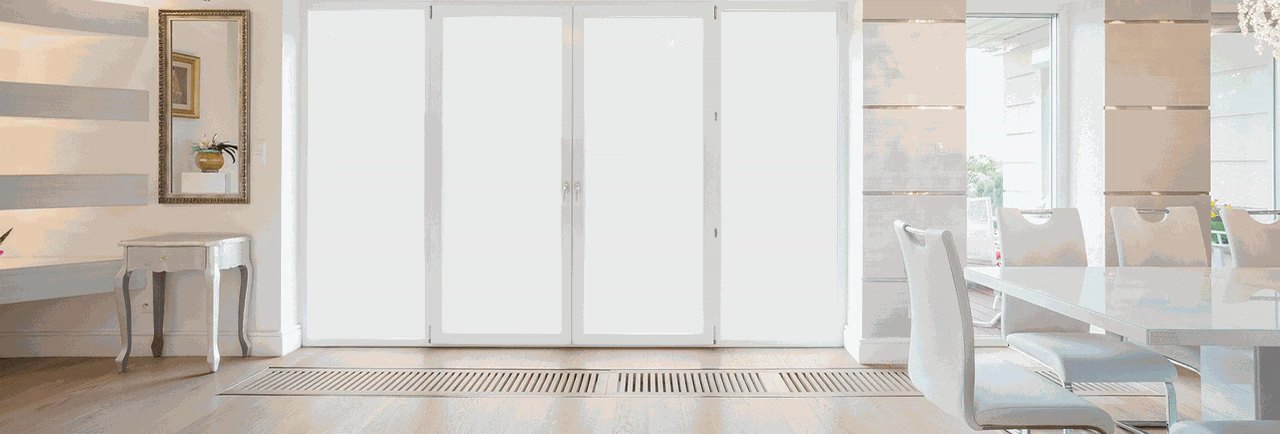
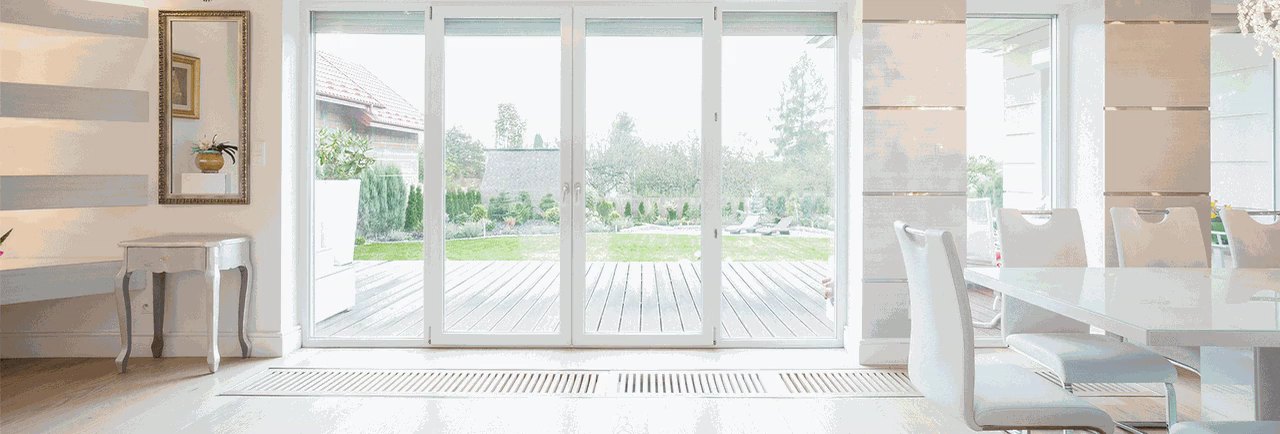 ClearFrosted
Drag the handle left and right - the photo is the same door, seconds apart.
Notice what changes between the two states: the same view, the same frame, the same hardware. Nothing is added to the door, nothing has to be drawn aside, and the ironwork or the mullion pattern is never covered.
PDLC vs SPD vs electrochromic - which one belongs on a front door
Three switchable technologies compete for the same aperture, and they are not interchangeable. The distinction that matters at a front door is whether the glass hides or merely darkens.
| Property | PDLC film | SPD | Electrochromic |
|---|---|---|---|
| How it switches | Scatters light - goes white/frosted | Absorbs light - goes dark tint | Absorbs light - chemical, goes dark |
| Switching speed | Under 0.1 s | About 1 s | 60-90 s in aircraft; minutes on facades |
| Clear-state transmission | 75-80% | Roughly 55-70% | Roughly 60-65% |
| Blocks the view completely | Yes - no silhouette visible | No - darkens but stays see-through | No - darkens but stays see-through |
| Solar heat rejection | Minimal | Up to 95% | High |
| Power | Only while clear (~5 W/m²) | Continuous while tinted | Only while changing (bistable) |
| Relative cost | Low to medium | High | High |
| Best suited to | Privacy: doors, bathrooms, partitions | Glare and heat: cars, yachts, sunroofs | Solar control: facades, aircraft |
The practical conclusion is uncomfortable for anyone shopping on specification sheets alone. SPD and electrochromic glass reject far more heat, but on a December evening with the hall light on they still leave a visible silhouette at the door - they are solar-control products. If the requirement is that a visitor on the step cannot see in, PDLC is the only one of the three that actually delivers it. If the requirement is that the afternoon sun stops cooking the hallway, the answer is a different technology, or a Low-E coating, or external shading.
Not sure which film a glazed front door needs?Send the pane sizes and one photo taken in daylight - we will tell you which build suits the exposure, then quote it.
Ask usRetrofit, laminated unit, or a new door?
There are three routes, and the right one depends on whether the door itself is staying.
- Retrofit film on the existing glass. The cheapest and least disruptive. The film is applied to the inner face of the pane, a busbar is run to the edge and a low-voltage driver is tucked into the frame or the ceiling void above. A single door leaf with a sidelight is typically a half-day job and the door, the hardware and any decorative grille stay exactly as they are.
- Replace the glass with a laminated switchable unit. The active layer is laminated between two panes, so it is protected, cleanable and suitable for a sealed or insulated unit. This is the right answer for a new door, a listed frame being re-glazed, or anywhere the film would be exposed to weather or heavy cleaning.
- A complete door system. Some suppliers ship the door with the switchable glass already glazed, wired through the hinge and tested. Cleanest result, longest lead time, highest cost.
The engineering detail that trips up more front-door projects than any other is the hinge. A door leaf moves; the driver does not. The cable has to cross the hinge line through a purpose-made hinge or a flexible loop that will survive tens of thousands of cycles. Decide this at survey stage - retrofitting a cable path into a finished frame is the expensive version of the same job.
Control: switch, remote, app, or the doorbell
Basic installations use a wall switch beside the door or a handheld remote - useful when the glazing sits behind a decorative grille and no cabling can be run through the panel. Smarter setups add a mobile app, voice control through Alexa, Google Home or Siri, and integration with Tuya, SmartThings or Apple Home.
The genuinely useful automations are the boring ones. Frost the sidelights at sunset and clear them at sunrise. Frost when the video doorbell is pressed, so the caller sees a frosted pane instead of the hallway. Frost on a schedule when the house is empty. Each of these is a scene, not a new product, and it is the part that changes daily life rather than the part that impresses at a showroom.
What it does to daylight, heat and the electricity bill
Be honest about the energy story. A frosted PDLC pane is not a blackout: it still admits most of the daylight, so a hallway does not go dark when privacy is switched on - that is a real advantage over fabric. But PDLC does not reject solar heat, so it will not replace Low-E glass or external shading on a west-facing entrance. Its honest contribution is fewer hours of artificial lighting, because the glass stays in use instead of being covered, plus the elimination of a maintenance item: no fabric to wash, no slats to dust, no mechanism to jam.
The running cost is small. At roughly 5 W per square metre and consumption only in the clear state, a typical front door and two sidelights - perhaps 1.5 m² of film - costs a few pence a day if left clear around the clock.
Specification checklist before you order
- Measure every pane separately. A door leaf, each sidelight and any transom are separate electrical zones with their own busbar.
- Decide the driver location early. Frame rebate, ceiling void or adjacent cupboard - and confirm there is a switched live there.
- Plan the hinge crossing. Purpose-made hinge or flexible loop; ask the supplier how many cycles it is rated for.
- Check the exposed side. A south- or west-facing entrance takes direct sun and a wide temperature swing; specify outdoor-rated film and sealed edges, or go laminated.
- Ask for the actual transmission figures for the exact build - clear-state VLT, haze in the frosted state - not a generic datasheet.
- Confirm the fail state in writing. It should be frosted on power loss.
- Look at a physical sample in daylight and after dark. Frost looks very different at night with the interior lit.
Frequently asked questions
What happens in a power cut? The glass frosts. Losing power is the private state, which is why the system is considered fail-safe for a home entrance.
Is it dangerous to have electricity in a door? The film runs on low voltage through an isolated driver - typically 24-72 V - and the conductive layers are fully encapsulated. The mains side stops at the driver, which is mounted in the frame or ceiling, not in the leaf.
Can it be fitted to an external door? Yes, with outdoor-rated film and sealed edges, or as a laminated unit. The limitation is UV exposure and edge sealing, not the switching principle.
Can I still see out when it is frosted? No, and that is the point. You keep the light - roughly 70-80% of it - but not a resolvable image. If you want to keep the view while cutting glare, that is an SPD or electrochromic requirement, not PDLC.
How long does it last? The film itself is typically rated for a decade or more of normal use; the low-voltage driver is the wear item and is designed to be replaceable without touching the glass.
The point of the whole exercise
A front door has to do two contradictory jobs: look open and stay private. Every traditional answer picks one. Switchable film is the first option that lets the same piece of glass be both - clear at breakfast, frosted at midnight, and unchanged in between.
Send us the pane sizes, a photo of the door in daylight, and where you can get power to, and we will come back with an itemised quote and the right film build for the exposure.
Measured your door glass yet?
Send the pane sizes and a photo - an itemised quote with the correct film build arrives within 24 hours.