How Electronic Dimmable Glass Works in Aircraft Windows
A Boeing 787 has no window shades - just a button, and glass that fades from clear to almost black in five steps. Here is the layer stack that does it, and why aviation chose electrochromic glass over PDLC.
Privacy film for doors, partitions and windows - switchable in a fraction of a second.
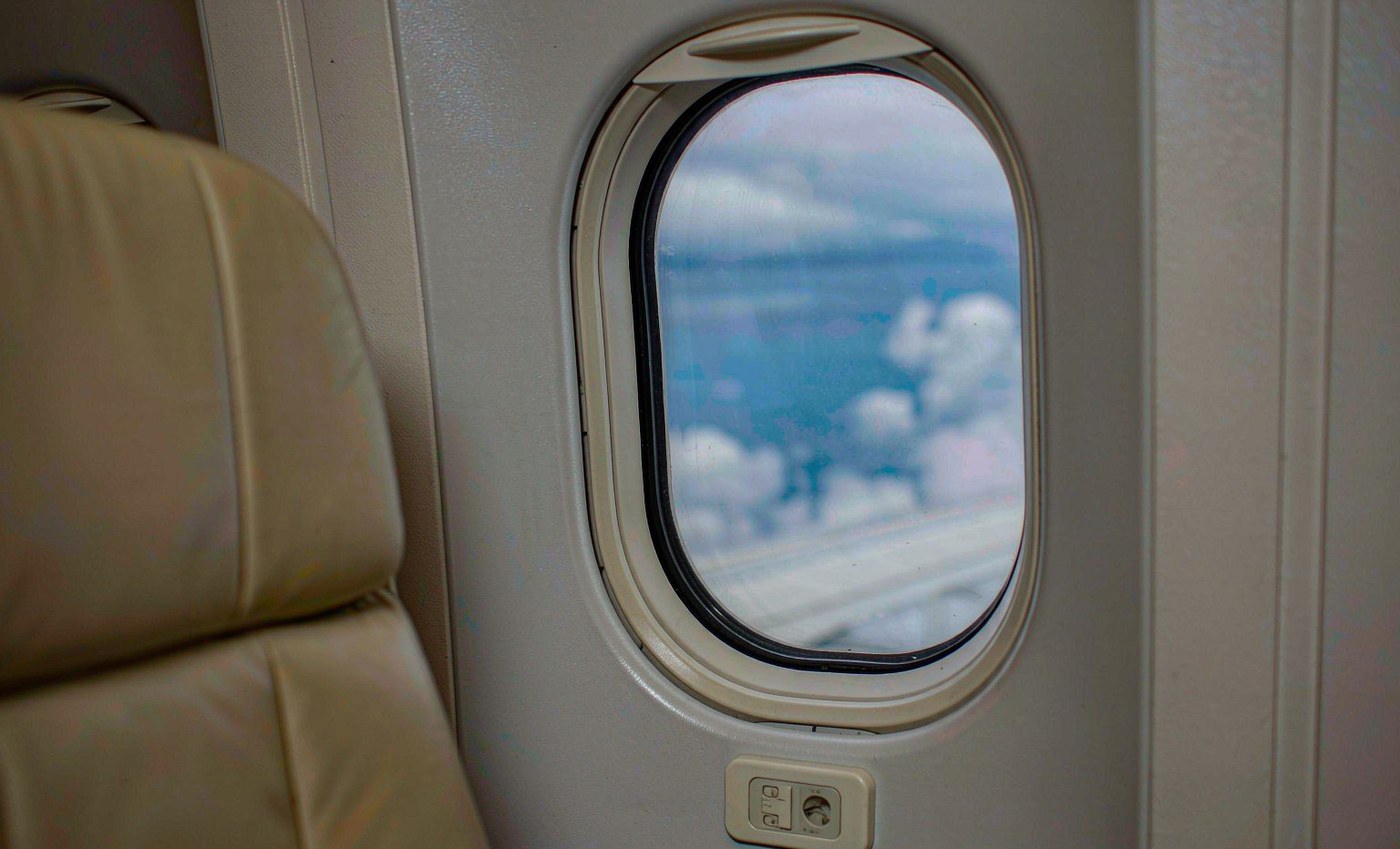 Clear
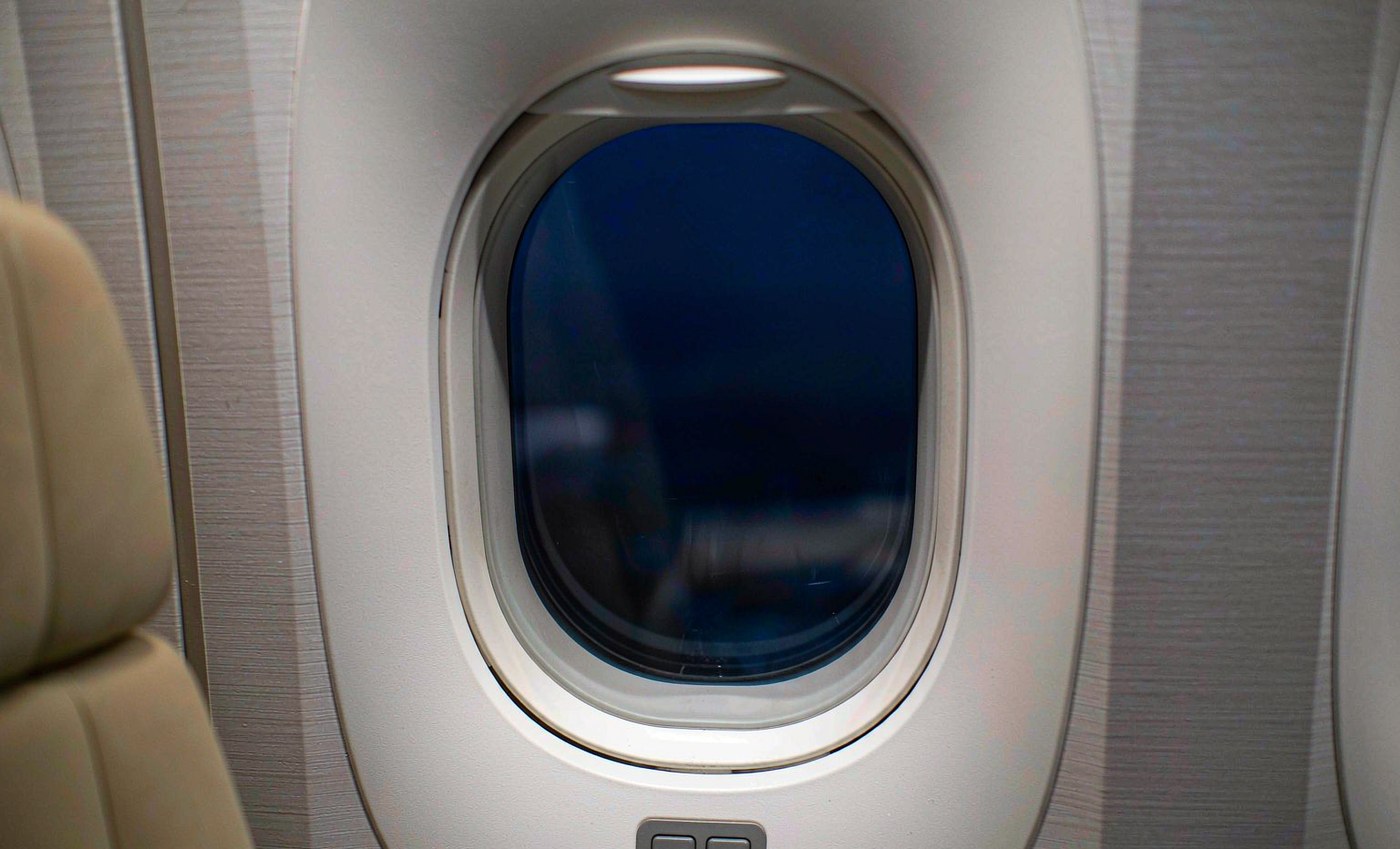 Dimmed
Fly on a Boeing 787 and the first thing frequent travellers notice is what is missing: there are no plastic shades to pull down. In their place is a button under each window, and a pane that fades from clear to a deep navy blue in five steps. It is the most visible piece of materials science most passengers will ever touch, and the reason it works the way it does explains a great deal about how switchable glass is chosen everywhere else.
The 787 has no window shades - and that is the whole point
The 787's windows are 10.7 by 18.4 inches, up to 65% larger than a conventional airliner window and roughly 30% larger than comparable widebodies by Boeing's own reckoning. A window that size makes the cabin feel enormously more open - and it would also let in an enormous amount of light and heat without some form of control. A pull-down shade on a pane that big would be unwieldy, would rattle, and would still only ever be fully open or fully closed.
Instead Boeing fitted electronically dimmable glass supplied by Gentex, a company better known for auto-dimming mirrors. Passengers get five discrete shade levels from a rocker button; the darkest setting blocks more than 99.99% of visible light as well as thermal infrared, keeping the cabin cool in direct sun while still letting the horizon stay faintly visible. Flight attendants can override every window from the Cabin Services System panel, and they do exactly that for take-off, landing and any emergency - external situational awareness is a safety requirement, not a comfort setting.
Clear © Smart Glass VIP
The stack: where the dimming actually happens
An electrochromic window is a thin electrochemical cell sandwiched inside the glazing. Working outward from the centre, the functional layers are: a central electrochromic layer that changes optical density, an ion-conducting electrolyte, an ion storage counter-electrode, and on both outer faces a transparent conductive oxide layer that spreads the current uniformly across the whole pane. The whole stack is laminated between the structural glass plies.
Apply a low voltage and ions shuttle from the storage layer into the electrochromic layer; the material oxidises or reduces and begins to absorb photons, so the glass darkens. Reverse the polarity and the ions migrate back; the glass clears. The critical point is that this is absorption, not scattering - the pane is genuinely blocking light rather than diffusing it, which is why the darkest state can reach 99.99% and why it also stops thermal infrared.
The numbers that actually matter
| Parameter | Typical electrochromic aircraft window |
|---|---|
| Shade levels | 5 discrete steps, fully clear to fully dark |
| Visible light blocked at darkest | Over 99.99% |
| Thermal infrared | Substantially rejected in the dark state |
| Transition time | 60-90 seconds clear to dark; longer as the cell ages |
| Power to hold a state | Bistable - no sustained current needed once set |
| Central override | Cabin Services System can undim all windows |
| Known wear points | The dimmer switches themselves, and slower switching as the EC layer degrades |
Two of those rows do most of the explaining. The transition takes a minute or more, which is fine when a passenger is settling in for an eight-hour flight and completely unacceptable on a bathroom door. And the cell is bistable: once it has reached a shade level it needs no power to stay there, which matters enormously when you are carrying hundreds of windows through a fourteen-hour flight on aircraft electrical power.
Why aviation chose electrochromic and not PDLC
PDLC - the polymer dispersed liquid crystal film used in most architectural privacy glass - is a scattering device. With power on, the liquid crystals align and the pane is clear; with power off, they scatter light and the pane turns an even milky white. It is superb at what it does, and it is the wrong tool for an aircraft window, for three specific reasons.
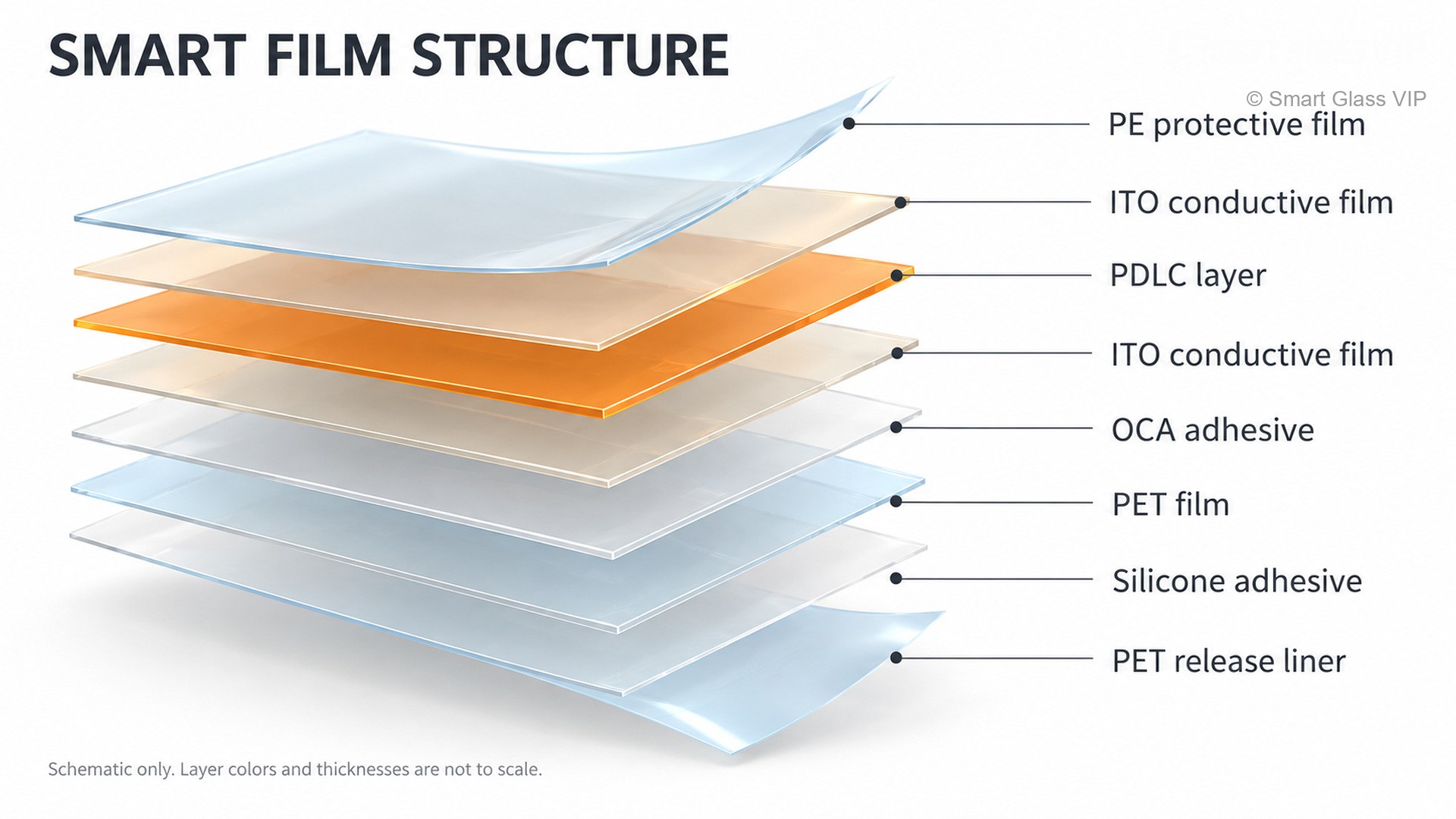
- Scattering is not shading. A frosted pane still transmits most of the light - it just spreads it out. In a cabin, that means a glowing white panel with the heat still coming through. Aviation needs the light and the infrared actually stopped, which requires absorption.
- PDLC needs power to stay clear. The clear state is the powered state. Hundreds of windows held clear for hours is a continuous electrical load and, more importantly, hundreds of continuously energised failure points.
- Only two useful states. PDLC is effectively on or off. The 787's five graduated levels are a comfort feature passengers use constantly, and they require a technology that can hold intermediate optical densities.
The trade runs the other way at home. On a bathroom door or a front entrance, nobody cares about rejecting infrared, but everybody notices a pixel-perfect frost that hides a silhouette - and nobody wants to wait ninety seconds for it. Different requirement, different physics, different product.
Want the same privacy response on your own glass?PDLC film switches in a fraction of a second and fits glass that is already installed. Send your pane sizes and we will quote the build.
Get a quoteSPD: the faster alternative
Suspended particle device glass takes a third approach. A film of microscopic light-absorbing particles is dispersed in a liquid suspension between conductive layers; applying voltage aligns the particles and the glass clears, removing it lets them drift into random orientation and block light. Commercial SPD-SmartGlass is quoted at blocking about 99.5% of visible light within roughly one second, and around 95% of solar heat in the tinted state - dramatically faster than electrochromic and far better at heat rejection than PDLC.
SPD has been used in automotive sunroofs, marine glazing, museum display cases and some business-jet windows. Its constraints are cost and the fact that the tinted state generally needs the voltage maintained. Against electrochromic it trades standby power for speed - which is exactly the right trade in a car, where a driver wants the roof dark now, and the wrong one in an aircraft, where the state changes a few times per flight.
Control logic, and why the override exists
Every aircraft window system is really two systems: a local control the passenger touches, and a supervisory control the crew owns. The passenger's five-level rocker is a comfort interface. The Cabin Services System override is an airworthiness requirement - cabin crew must be able to restore visibility to every window in the aircraft during take-off, landing and any abnormal situation, because the ability to see outside is part of how the cabin is assessed in an emergency.
The maintenance history is instructive for anyone specifying switchable glass anywhere. The dimmer switches on the 787 fleet have worn faster than operators expected, simply because a long-haul passenger may cycle a single window dozens of times across boarding, meals, sleep and descent. Boeing supplies the replacements as proprietary parts, and the switches have quietly become a durable aftermarket line. The lesson is not that the technology is fragile; it is that the control interface, not the glass, is usually the first thing to fail - so make the switch replaceable without touching the pane.
What this means on the ground
Almost every mistake in specifying switchable glass comes from borrowing a technology designed for one requirement and applying it to another. The selection logic that aircraft and buildings have converged on is straightforward:
- If the requirement is "nobody can see in" - a front door, a bathroom, a changing room, a glass partition beside a meeting table - the answer is PDLC, because it is the only common technology that removes the image rather than dimming it, and because it switches in a fraction of a second.
- If the requirement is "the sun stops cooking the room" - a west-facing curtain wall, a sunroof, an atrium - the answer is electrochromic or SPD, because solar heat rejection needs absorption, not diffusion.
- If the requirement is both, it is usually two products: switchable film for the privacy panes, and a Low-E coating, external shading or electrochromic glazing for the solar-exposed ones.
On the architectural side, electrochromic glazing has moved steadily from aircraft into facades - large-area EC units now run on building control systems, trading slow transitions for very low standby power and serious solar control. PDLC, meanwhile, has gone the other direction: cheap enough to be applied as an adhesive film to glass that is already installed, which is why it dominates retrofit privacy work in homes, clinics, offices and retail.
Where the technology goes next
Three directions are visible in current development work. Larger and flexible substrates are pushing switchable layers onto curved and oversized glazing, not just flat rectangular panes. Sensor-driven automation is replacing manual control - glass that reads sun angle, occupancy and glare and settles on a level by itself, which suits both aircraft cabins and office facades. And the switchable layer is increasingly being treated as one function in a stack that also carries photovoltaics and transparent display film, so that a single pane can shade, generate and present.
What will not change quickly is the underlying split. Absorption for heat, scattering for privacy. Any specification that ignores that distinction ends up with an expensive pane doing the wrong job.
Frequently asked questions
Is the 787 window actually glass that changes colour? The colour change is in an electrochromic gel layer laminated between the glass plies. The glass itself is passive; the active chemistry sits inside it.
Why does it take so long to darken? Because it is an electrochemical process - ions have to physically migrate through the cell. That is the price of bistability: once set, the state holds with no power.
Could PDLC be used on an aircraft window? It would give privacy, not solar control, and it would need continuous power to stay clear. That is the opposite of what a cabin needs.
Can I buy aircraft-type dimming glass for a house? Not the certified aviation units - those are type-approved parts. For a home, the practical options are PDLC film for privacy and architectural electrochromic glazing for solar control.
Which one lasts longer? Both are long-lived; the wear items are the control electronics and, on EC units, the slowing of the transition as the cell ages. Design for serviceable drivers and replaceable switches.
Choosing for your own glass
If your requirement is privacy - a door, a bathroom, a partition, a clinic consulting room - switchable PDLC film is the direct descendant of everything above: same idea, different physics, and a fraction of a second instead of ninety of them. Send us the pane sizes and how the space is used, and we will tell you honestly whether film is the right answer or whether you need a solar-control product instead.
Need privacy on existing glass?
Send your pane sizes and a photo - we will confirm the right film build and quote within 24 hours.