PDLC Smart Film vs DLC Blackout Film: Which One Fits the Project
Both films switch on a button. They do not do the same job. The one decision that changes everything is what the glass looks like when the power is off.
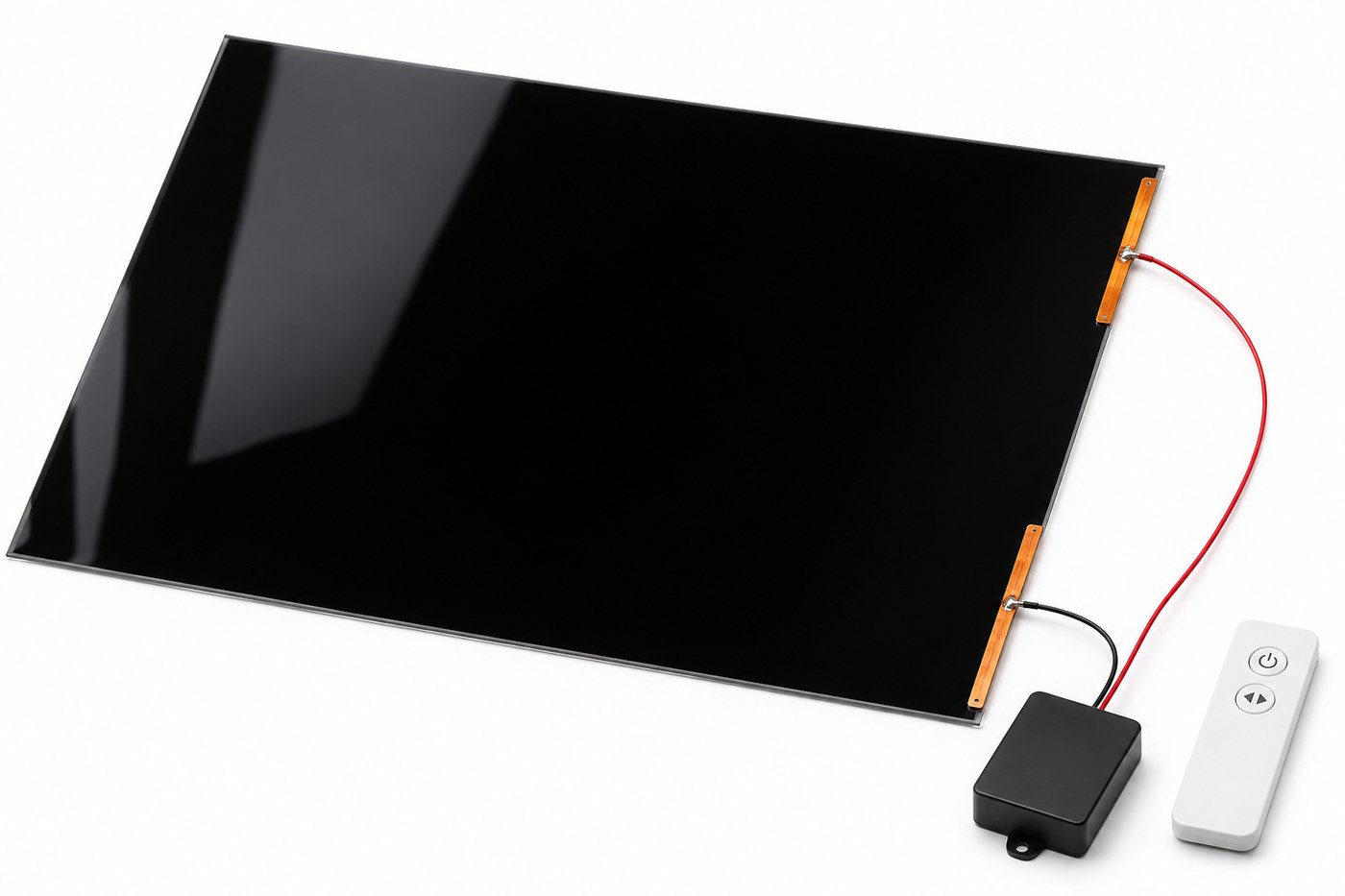
Same switch, different off-state
PDLC film scatters light when it is off, so the pane reads as frosted white. DLC dye-doped film absorbs light instead, so the off-state is deep dark. That single difference decides whether a room can be darkened at all.
The difference that decides the whole specification
Switchable film is often sold as one category with grades. It is not. There are two different mechanisms:
- PDLC (polymer dispersed liquid crystal) - the liquid crystal droplets scatter incoming light when no power is applied. The glass turns milky white and you cannot see through it, but light still passes and the room stays bright.
- DLC (dye-doped liquid crystal) - a dichroic dye absorbs light instead of scattering it. With the power off the pane goes deep dark, which is what a blackout effect actually requires.
The practical consequence: if the goal is privacy, either film works. If the goal is a dark room, only the dye-based product reaches it. We treat DLC as a separate product line, not as a premium grade of PDLC - the two are quoted and specified on their own terms.
PDLC smart film: the workhorse
This is the volume product, and for most privacy retrofits it is the right answer. It is applied self-adhesive to existing glass, so no glazing work and no replacement.
What the specification sheet says
- Clear grade: 84-85% light transmission when powered, about 4% when off; haze 4% on / 95% off.
- Super Clear and Ultra Clear grades go higher when powered (87-88% and 91-92%) at the same off-state haze of 95%.
- Power: 60V AC (48V on request), roughly 5 W/m² while clear. Size the transformer at 8 W/m² of film plus headroom for zoning.
- Film thickness: about 0.38-0.40 mm, normal thickness tolerance.
- Width: self-adhesive up to 1800 mm; non-adhesive film for lamination up to 2000 mm.
- UV and IR: the sheet lists UV blocking 99% and above, IR blocking 98% and above. Note that IR blocking is not the same as an equivalent saving on air-conditioning.
- Response: under 10 ms; view angle 160°; operating range -30°C to 70°C.
- Supply: film lead time 1-3 working days, no MOQ (1 m² is a valid order), 2-year film warranty and 1-year transformer warranty.
Where it wins
- Office partitions, meeting rooms, clinic and bathroom glazing - anywhere the brief says "privacy", not "darkness".
- Projection surfaces and switchable signage on the same pane.
- Budgets that need to land, and schedules that cannot wait: this is a mature, high-volume line.
- Installers who already do premium window film - same discipline, one extra step being the wiring.
Where it stops
- The off-state is white, not black. It will never look like architectural dark glass.
- It is a privacy device, not a blackout device. A bedroom that must go dark is the wrong application.
- Heat control is a secondary benefit, not the reason to buy it.
DLC dye-doped film: the blackout line
DLC is the product you specify when the brief is explicitly about darkness: hotel rooms, home theatres, bedrooms, exhibition halls, RV windows, and high-end residential work where the exterior view of the glass matters as much as the privacy.
What it is
- A separate product line from Smart Film, built on dye-doped liquid crystal rather than dispersed droplets.
- Self-adhesive only, with a maximum width of 1500 mm. It is specified on its own, not derived from PDLC data.
- Off-state is deep dark. We do not publish a light-transmission figure for it, because a single number would not describe a product whose performance depends on the glass it is bonded to - ask for the current data sheet for your project.
- Vehicle-grade DLC exists as its own line as well: thinner, built to conform to curved glass, and wired through a DC12V to AC60V car power supply, not an architectural transformer.
What it costs you
- More than PDLC film at the same area. It is not a price upgrade of a PDLC roll; it is a different product.
- Clear state carries a slight tint and does not reach the transmission of a Clear PDLC sheet. If the client expects "invisible when on", say so before they order.
- Fewer factories run it at volume, so treat lead time as a question to ask rather than an assumption.
Vehicle glazing is subject to local window-tint regulations. Check the rules in your market before installation.
Side by side
| PDLC smart film | DLC blackout film | |
|---|---|---|
| Off-state look | Milky white, like frosted glass | Deep dark, near-black |
| How it blocks | Light scattering | Dye absorption |
| Room goes dark? | No - light still enters | Yes, that is the point of the line |
| Clear-state clarity | 84-85% (Clear grade); higher grades available | Slight tint, lower than Clear PDLC |
| Max width | 1800 mm self-adhesive / 2000 mm non-adhesive | 1500 mm |
| Cost level | Baseline | Higher per m² |
| Typical brief | Office, meeting room, clinic, bathroom, projection | Hotel room, home theatre, bedroom, showroom, RV |
How to choose in under a minute
- Ask what the room must do at night. If the answer is "nobody can see in", PDLC film is enough and costs less. If the answer is "it must be dark", you are specifying DLC.
- Check the clear state expectation. If the client expects the glass to look untouched when powered, PDLC Clear or Ultra Clear is the honest answer. DLC keeps a slight tint.
- Check the glass. Curved vehicle glass and small odd shapes suit the thinner vehicle-grade lines; large architectural panes need to respect the maximum width of the film you choose.
- Price the whole circuit, not the film. Transformer, wiring, zoning and controls belong in the comparison. A cheaper film with an undersized transformer is not cheaper.
Two mistakes we see most often: comparing the two lines as "good, better, best" when they solve different problems, and budgeting a DLC project against a PDLC roll price, then discovering halfway through that it is a different product category.
What to send us for a quote
Send the pane sizes, the application (office partition, hotel room, vehicle side window), the quantity, and how you want the panes zoned. We reply with an itemised quote, not a single blended number, because the wiring plan usually decides the real cost.
Before you commit to a full order: one sample piece of 105 x 165 mm with a AA battery handle is free, and extra pieces are USD 8 each. Ten minutes with a sample on a real pane settles more arguments than a spec sheet.
FAQ
Is DLC film a premium grade of PDLC film?
No. It is a separate product line on dye-doped liquid crystal. PDLC figures such as clear-state transmission do not transfer to it, and we quote the two separately.
Can PDLC film replace blackout curtains?
No. With the power off it scatters light and reads as frosted white - privacy, not darkness. Projects that need a dark room are specified with DLC.
Do both need a transformer?
Yes. Size it at 8 W/m² of film with headroom for zoning. Vehicle DLC uses a DC12V to AC60V car power supply, not an architectural transformer.
Which one should an installer stock first?
PDLC self-adhesive film. It covers the widest range of requests, ships in 1-3 working days, and has no MOQ - 1 m² is a valid order. Add DLC when a client brings you a blackout brief.
Talk to an engineer
Send your dimensions and application - itemised quote within 24 hours, no MOQ.